
Seasonal outdoor dining contingency plans are operational strategies that help restaurants preserve a reliable guest experience when weather, temperature, or other seasonal conditions make patios and terraces difficult to use. Integrated into the core experience, these plans connect forecasting, guest communication, flexible seating, staffing, and indoor alternatives rather than treating bad weather as an afterthought. Their importance is underscored by the National Restaurant Association’s 2024 industry report, which found that 45% of restaurant operators said outdoor dining was more important to their business than it was before the pandemic. A strong plan protects both service continuity and guest confidence through clear decision rules, accessible backup spaces, and thoughtful seasonal design.
How Seasonal Outdoor Dining Contingency Plans Protect the Core Guest Experience
A seasonal outdoor dining contingency plan is a documented set of procedures for keeping service safe, comfortable, and consistent when outdoor conditions change. The National Restaurant Association’s operational guidance emphasizes that outdoor service requires attention to local rules, food safety, sanitation, and site-specific conditions. In practice, the plan covers more than umbrellas: it determines when a patio remains open, how reservations are moved, what staff tell guests, and how the restaurant maintains the intended quality of the meal indoors.
The plan works best when it is treated as part of the restaurant’s service design. Its related forms include weather-triggered seating protocols, seasonal comfort measures, reservation-recovery procedures, and emergency closure plans. These components connect because a decision to move diners affects the floor plan, staffing, food timing, accessibility, and communication at the same time.
Weather thresholds and decision rules
Weather thresholds are predefined conditions that prompt a specific operational action, such as pausing new patio seating or moving guests indoors. A useful protocol identifies who makes the decision, which forecasts or on-site observations inform it, and how much lead time is needed to contact guests. Relevant factors can include lightning risk, high winds, heavy rain, extreme heat, cold, and air-quality alerts. The National Weather Service advises people to seek shelter indoors when thunder is heard; restaurants should therefore establish a clear lightning response rather than relying on staff judgment in the moment.
Thresholds should be tailored to the venue, local regulations, equipment, and guests’ needs. A covered patio may remain usable during light rain, for example, but wind can make awnings or heaters unsafe. The National Oceanic and Atmospheric Administration’s heat-safety guidance also underscores that heat risk depends on factors such as temperature, humidity, exposure, and individual vulnerability. Managers can turn these inputs into a simple status system—open, limited, or closed—and assign an accountable decision-maker for every shift.
Reservation moves and indoor backup capacity
A reservation-transfer protocol defines how a booked outdoor table is reassigned when conditions change. It should explain whether guests are moved to an equivalent indoor table, offered a different time, or given a cancellation option under the restaurant’s stated policy. The backup plan is most credible when managers know the indoor capacity they can protect for patio reservations and how that capacity affects walk-ins and accessibility.
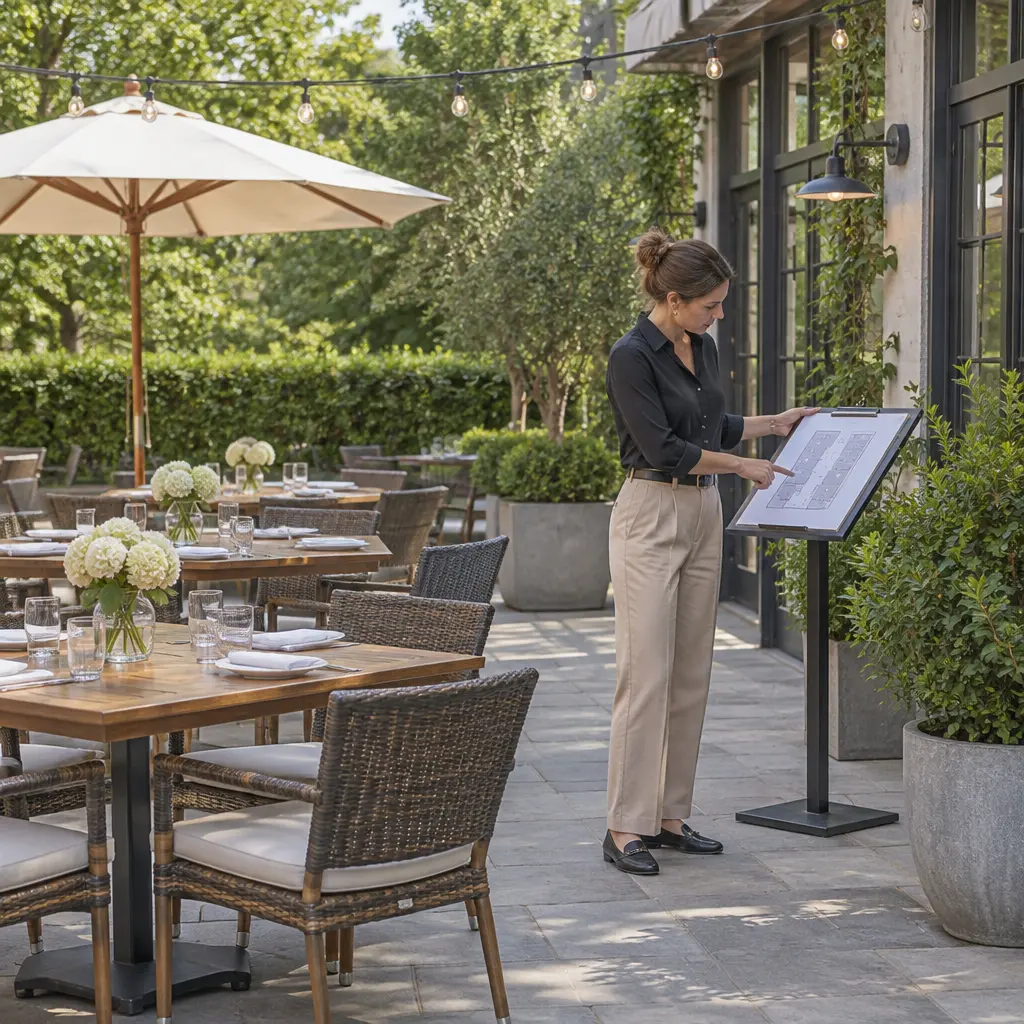
The National Restaurant Association reported that 70% of adults said they would likely choose a restaurant that offers outdoor dining when the weather is warm. That demand makes capacity planning consequential: a patio can draw guests, but a weather disruption can create frustration if the restaurant has no credible alternative. A seating map that marks flexible tables, accessible routes, and parties that can be accommodated together helps teams make quick, fair decisions without promising space that does not exist.
Guest communication and service recovery
Guest communication is the process of explaining weather-related changes promptly, consistently, and with practical options. Restaurants can include a weather note in reservation confirmations, send updates through their booking platform, and train hosts to explain the indoor alternative before guests arrive. Clear language should distinguish between a change in seating and a cancellation, and should avoid promising an outdoor table when conditions remain uncertain.
Service recovery means addressing the inconvenience in a way that preserves trust without compromising safety. Depending on the situation, staff may offer a choice of available seating, a revised reservation time, or a policy-based cancellation. The U.S. Federal Emergency Management Agency’s guidance on emergency communications stresses the value of timely, accurate, and actionable information. Applied to dining, the principle is straightforward: tell guests what has changed, what the restaurant can offer, and when the next update will come.
How Seasonal Outdoor Dining Contingency Plans Support Safety and Comfort
Once decision rules and guest options are established, the next layer is the physical environment. Seasonal comfort measures are equipment and procedures that make outdoor service usable across changing conditions, while preserving safety and the restaurant’s service standards. They include shade, wind protection, drainage, lighting, heating or cooling equipment, and clear walkways. These measures are not substitutes for closing a patio when conditions are hazardous; they extend comfortable use within safe limits.
Heat, sun, and air-quality contingencies
A heat contingency is a set of controls for reducing heat exposure and responding to heat-related risk. Practical measures include shaded seating, drinking water, shorter outdoor assignments for employees, and a defined threshold for limiting or suspending patio service. The U.S. Centers for Disease Control and Prevention notes that heat can cause serious illness and recommends taking steps to stay cool and hydrated. Restaurants should also monitor local air-quality advisories, since smoke and pollution can make outdoor dining unsuitable even when temperatures are comfortable.
Shade and airflow should be assessed by time of day and season because the sun’s angle changes, and a canopy that works at lunch may not protect an evening service area from reflected heat. Managers should inspect shade structures, fans, and electrical equipment before the season begins and follow manufacturer instructions. If conditions exceed the restaurant’s safe operating limits, moving service indoors is the contingency—not a failure of the plan.
Cold, rain, wind, and storm response
Cold-weather and rain contingencies prepare the restaurant to respond to falling temperatures, precipitation, and wind without creating new hazards. They may include covered seating, non-slip flooring, wind screens, outdoor-rated heaters, and a procedure for moving guests before conditions deteriorate. Equipment must be suitable for its location and installed and operated according to applicable fire, building, and local requirements. The U.S. Consumer Product Safety Commission warns that fuel-burning devices can produce carbon monoxide; portable fuel-burning heaters should never be used indoors or in enclosed spaces.
For storms, the plan should distinguish manageable rain from conditions that require immediate shelter. The National Weather Service’s lightning safety guidance supports moving people to a substantial enclosed building when thunder is audible. Staff should know which doors and routes to use, how to assist guests with mobility needs, and who verifies that the outdoor area is clear. Wind limits for umbrellas, awnings, and temporary structures should follow the equipment manufacturer’s specifications and local safety rules.
Food safety, sanitation, and accessible routes
Food safety in outdoor service means maintaining safe handling, storage, and sanitation practices despite exposure to heat, pests, dust, and changing conditions. The U.S. Food and Drug Administration’s Food Code provides a model for retail food safety, including temperature control and protection from contamination; local jurisdictions adopt and enforce their own requirements. Restaurants should keep cold and hot foods within required limits, protect service items, and define what happens to food and equipment during a rapid patio closure.
Accessible routes are continuous, usable paths that allow guests and staff to move safely between outdoor seating, indoor spaces, and facilities. Tables, heaters, cables, wet-floor signs, and temporary barriers can obstruct these paths if the layout is not checked after weather-related changes. The U.S. Access Board’s accessibility standards provide technical requirements for accessible routes and spaces. A pre-service inspection should therefore include both the patio configuration and the route to the indoor backup area.
How Seasonal Outdoor Dining Contingency Plans Become Repeatable Operations
A contingency plan becomes part of the core experience when employees can execute it consistently and management reviews its results. This requires role clarity, training, supplies, and a feedback loop. The restaurant should assign responsibility for monitoring forecasts, authorizing a seating change, updating reservations, inspecting equipment, and documenting incidents. Simple checklists reduce dependence on memory during busy service.
Staffing, training, and shift handoffs
Staffing procedures identify how roles and workloads change when outdoor tables are opened, reduced, or moved indoors. Hosts may need to contact reservations, servers may inherit a revised section, and managers may need to coordinate table turns and guest requests. Training should rehearse common scenarios, including a sudden downpour, a heat advisory, and a lightning alert. A shift handoff should record the current patio status, forecast concerns, equipment condition, and any guest commitments already made.
The U.S. Bureau of Labor Statistics reported that food preparation and serving occupations accounted for about 12.3 million jobs in May 2023. That scale illustrates why operational guidance must be practical and teachable: restaurant teams vary in size and experience, and procedures need to work for new employees as well as managers. Short role cards, a designated decision-maker, and a pre-shift briefing can make the plan easier to apply consistently.
Technology, monitoring, and operational metrics
Monitoring combines reliable weather information with the restaurant’s own observations and reservation data. Managers can use official weather alerts, local forecasts, reservation-platform messaging, and a written patio status log. Useful performance measures include the number of weather-related seating changes, time between a forecast warning and guest notification, successful reservation transfers, cancellations, safety incidents, and guest feedback. Tracking these measures over a season helps reveal whether thresholds are too cautious, too permissive, or poorly communicated.
A chart in an operating handbook can map conditions to actions: for example, “monitor” for a developing forecast, “limit” for conditions approaching the venue’s threshold, and “close” for a safety alert. This visual aid should identify the person authorized to act and the communication channel to use. Data should support judgment rather than replace it; official warnings and observed hazards take precedence over a routine reservation target.
Seasonal review and real-world application
A seasonal review compares planned procedures with what actually happened, then updates training, equipment, and guest messaging. For example, a restaurant in a coastal city may keep a covered patio available during light rain but move guests indoors when wind reaches the awning’s specified operating limit. A high-desert restaurant may use heat alerts to reduce afternoon patio seating, while a cold-climate venue may offer outdoor tables only when heaters, safe surfaces, and indoor backup capacity are all confirmed. These are illustrative applications; each business must follow local codes, site conditions, and equipment instructions.
The review should include employee feedback as well as guest outcomes. If teams repeatedly struggle to move large parties, the indoor backup map may need revision. If guests receive updates too late, reservation messages may need an earlier trigger. Recording near misses, not only injuries or complaints, can reveal weak points before they become serious incidents.
Conclusion: Make Outdoor Dining Resilient by Design
Seasonal outdoor dining contingency plans are strongest when weather thresholds, reservation transfers, guest communication, comfort measures, food safety, accessibility, and staff training operate as one system. Outdoor dining can attract guests, but its value depends on a reliable response when conditions change. The National Restaurant Association’s findings on the continued importance of outdoor dining reinforce the business case for treating contingency planning as part of service design, not an emergency add-on.
Restaurant operators can start by assigning a decision-maker, defining venue-specific weather triggers, mapping indoor alternatives, and rehearsing a few realistic scenarios before the next season. Review local health and building requirements, consult equipment guidance, and evaluate outcomes at the end of each season. The result is a safer, clearer, and more dependable dining experience for guests and staff alike.
Sources: National Restaurant Association, 2024 State of the Restaurant Industry Report, https://restaurant.org/research-and-media/research/research-reports/state-of-the-restaurant-industry/; National Weather Service, Lightning Safety, https://www.weather.gov/safety/lightning; National Oceanic and Atmospheric Administration, Heat and Health, https://www.noaa.gov/heat; Federal Emergency Management Agency, Planning Considerations for the Whole Community, https://www.fema.gov/emergency-managers/national-preparedness/plan; Centers for Disease Control and Prevention, Heat and Health, https://www.cdc.gov/heat-health/; U.S. Consumer Product Safety Commission, Carbon Monoxide Information Center, https://www.cpsc.gov/Safety-Education/Safety-Education-Centers/Carbon-Monoxide-Information-Center; U.S. Food and Drug Administration, Food Code, https://www.fda.gov/food/retail-food-protection/fda-food-code; U.S. Access Board, Guide to the ADA Accessibility Standards, https://www.access-board.gov/ada/guides/; U.S. Bureau of Labor Statistics, Occupational Employment and Wages, May 2023, https://www.bls.gov/oes/2023/may/oes350000.htm.