
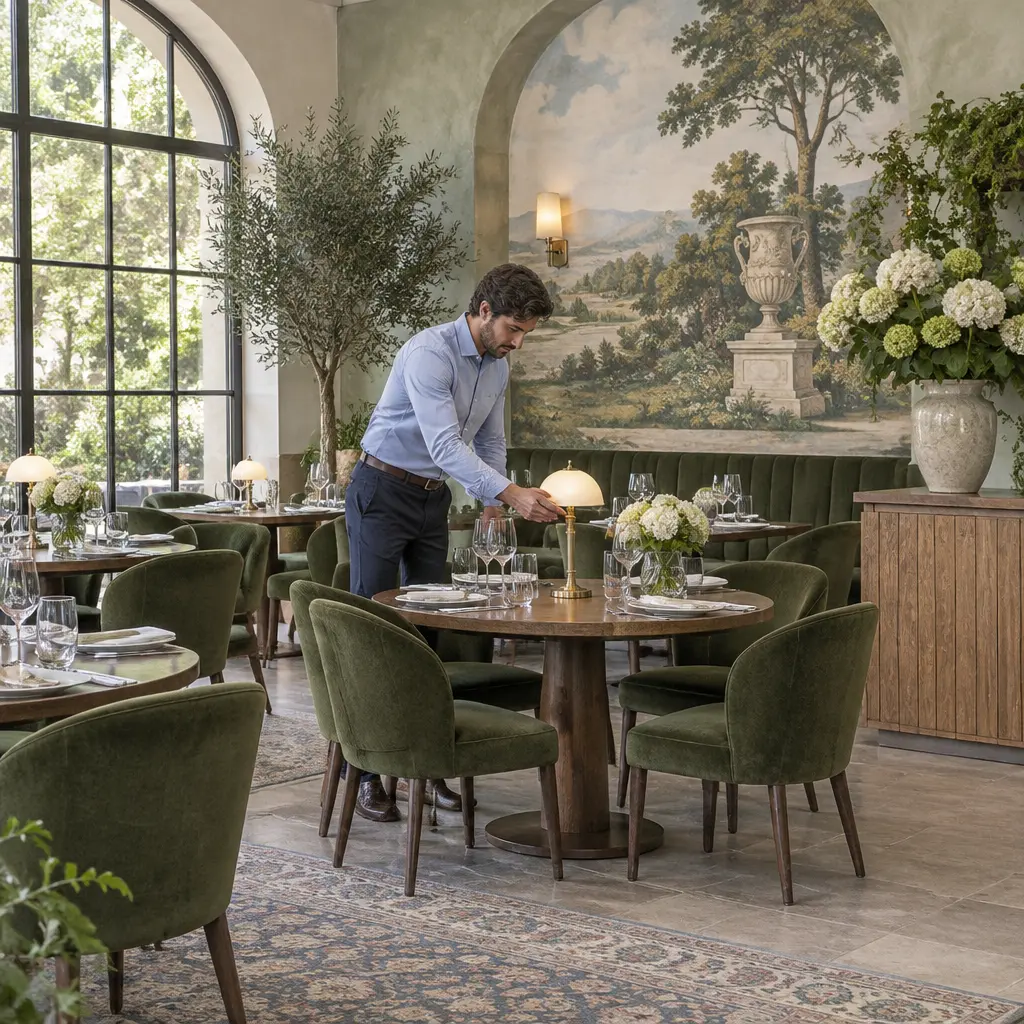
Immersive dining uses sensory design, storytelling, and interaction to make a meal feel like an experience rather than simply a service. Its psychological appeal rests on how people perceive multisensory cues, respond to novelty and social participation, and form memories around emotionally meaningful events. Research on flavor perception, environmental psychology, and consumer experience helps explain why themed restaurants and theatrical meals can feel memorable—and why coherence, comfort, and thoughtful execution matter. This article examines the psychology behind immersive dining, the sensory and narrative techniques it uses, the evidence for their effects, and practical examples and limitations.
Immersive Dining and Its Psychological Foundations
Immersive dining is a meal designed to engage guests beyond taste and service through coordinated elements such as lighting, sound, décor, narrative, performance, technology, and guest participation. It is not a single formal category of restaurant: the term can describe anything from a themed room to a multi-course performance. The common feature is an intentionally designed environment that shapes how diners attend to, interpret, and remember the meal.
The psychology behind the format is grounded in multisensory perception. In a 2006 review in Nature Reviews Neuroscience, neuroscientist Charles Spence and colleagues explained that flavor is constructed through the integration of taste, smell, texture, and other sensory signals. This means the room is not merely a backdrop: sound, visual presentation, and context can influence how food is experienced. Immersive dining also connects with research on expectation, emotion, social interaction, and memory.
The topic matters commercially as well as psychologically. The National Restaurant Association’s 2024 industry report described a U.S. restaurant sector with more than one million locations and projected sales of $1.1 trillion for the year. Those figures do not establish that immersive dining is more profitable than conventional dining, but they show the scale of a competitive sector in which operators seek ways to differentiate an outing. The sections below explain the sensory mechanisms, narrative and social dimensions, supporting evidence, real-world formats, and design considerations.
Sensory Design Shapes Immersive Dining Perception
Sensory design is the deliberate coordination of stimuli—such as aroma, lighting, color, sound, temperature, and texture—to influence the atmosphere and interpretation of a meal. Spence and colleagues’ account of multisensory flavor perception offers a precise foundation: what people call “flavor” is not produced by taste alone but emerges from the brain’s integration of information from multiple senses. Sensory design can therefore alter the setting in which food is perceived, even when the ingredients themselves remain unchanged.
Flavor and Cross-Modal Expectation
Cross-modal expectation occurs when information from one sense shapes expectations about another. A dish served in a dim, candlelit room may be interpreted differently from the same dish served under bright clinical lighting; a carefully chosen soundtrack can also change the perceived character of a meal. In a 2014 study published in Flavour, psychologist Charles Spence and colleagues reviewed evidence that music can influence aspects of food and drink perception, including judgments of taste and flavor. Such effects are contextual rather than guaranteed: a cue may support one dish or mood and clash with another.
A useful design principle is congruence: sensory cues should make sense together. A maritime story supported by sea-inspired sounds, blue-toned lighting, and suitable menu language can create a more coherent expectation than unrelated effects layered into the same space. Congruence does not mean every element must be literal. It means the cues should help guests understand the experience rather than compete for attention.
Sound, Lighting, and Attention
Sound and lighting influence attention, perceived atmosphere, and the ease of social interaction. Soft, well-controlled sound can support conversation, while abrupt or excessive noise may make it harder for guests to hear staff and companions. Lighting can direct attention to a plate, performer, or changing scene, but very low illumination may make reading menus or eating comfortably difficult. These effects matter because immersive design has to balance theatrical focus with the practical needs of dining.
The World Health Organization’s environmental-noise guidance identifies noise as a public-health concern and recommends reducing exposure to harmful levels. That guidance is not a restaurant-design specification, but it reinforces a relevant point: sound is not an unlimited creative resource. Operators should test volume and acoustics in the actual room, account for guests with sensory sensitivities, and provide quieter areas or alternatives where feasible.
Visual Presentation and Environmental Cues
Visual cues include the room’s architecture, tableware, uniforms, projections, menu design, and plating. They help establish a setting and guide expectations about what kind of meal is being served. A 2014 review by Spence and colleagues on multisensory food design discussed how visual presentation can affect expectations and the perceived qualities of food. For immersive dining, the practical implication is not that elaborate visuals automatically improve a dish, but that presentation can make the meal’s concept easier to read and remember.
Sensory design is most effective when it gives guests a clear focus without overwhelming them. A changing projection, for example, may add context between courses, while continuous high-intensity visual effects can distract from conversation or food. Once the environment establishes a sensory frame, narrative and participation can give that frame meaning.
Storytelling and Participation Deepen Immersive Dining
Narrative immersion is the process of becoming mentally and emotionally absorbed in a story. In dining, a narrative may be communicated through a menu, a host’s introduction, performers, the sequence of courses, or changes in the room. Psychologist Melanie Green and communications scholar Timothy Brock described “transportation into a narrative world” in a 2000 study in the Journal of Personality and Social Psychology. Their work concerns stories rather than restaurants specifically, but it helps explain why a coherent plot or premise can capture attention and shape interpretation.
Narrative Structure and Course Sequencing
Narrative structure organizes an experience into meaningful stages, such as an introduction, development, turning point, and conclusion. A tasting menu can use course order to create progression: a first course introduces a place or theme, later dishes develop it, and a final course provides a sense of resolution. The story may be explicit, with characters and plot, or subtle, conveyed through ingredient origins and changing sensory cues.
Coherence is important because guests need to understand how the elements relate. A 2015 paper by researchers Pine and Gilmore revisiting the “experience economy” argued that memorable experiences benefit from a clear theme and consistent execution. This framework is widely used in experience design, though it is not proof that themed dining automatically improves satisfaction. In practice, operators can evaluate whether guests understand the concept, whether each course contributes to it, and whether the narrative leaves enough room for the food itself.
Guest Agency and Interactive Dining
Guest agency is the degree to which diners can make choices or influence what happens. Interactive formats may invite guests to select ingredients, solve a clue, speak with performers, or choose between narrative paths. Participation can make a meal feel more personal, but it should remain optional and accessible. Guests who prefer conversation or privacy should not have to perform to receive good service.
Self-determination theory, developed by psychologists Edward Deci and Richard Ryan, identifies autonomy, competence, and relatedness as important psychological needs. Applied cautiously to dining, the framework suggests that meaningful choices, understandable interactions, and social connection may support a positive experience. It does not mean that every interactive feature will be enjoyable: confusing instructions, forced participation, or choices with no apparent consequence can undermine the sense of agency.
Social Connection and Shared Attention
Immersive meals are often shared events. Diners watch the same performance, encounter the same reveal, or discuss a surprising course, creating shared attention and conversation. Social psychologist Barbara Fredrickson’s broaden-and-build theory proposes that positive emotions can expand momentary thought and action repertoires and help build enduring personal resources. The theory is not specific to restaurants, but it offers a useful lens for understanding why enjoyable shared moments may contribute to connection and positive recollection.
The social benefit depends on the group and setting. A theatrical reveal may delight one table and interrupt another. Designers can support different preferences by offering clear information about the format, keeping performances at a considerate volume, and ensuring that companions can still interact with one another. Storytelling and participation are strongest when they invite connection rather than monopolize attention.
Emotion and Memory Make Immersive Dining Memorable
Memory is not a complete recording of an event; it is reconstructed from selected details, emotional responses, and later interpretation. A meal that includes novelty, a meaningful story, or a shared surprise may leave more distinctive memories than a routine visit. This possibility helps explain the appeal of immersive dining, although a memorable experience is not necessarily a better one if the food, comfort, or service falls short.
Novelty, Surprise, and Emotional Salience
Novelty is the experience of encountering something unfamiliar, while emotional salience describes how strongly an event captures attention because it matters or feels significant. A surprising presentation, an unexpected course, or a shift in the room can make a moment stand out. Neuroscience research on memory, including work by Elizabeth Kensinger on emotional memory, shows that emotional content can influence what people remember, though the effects vary by person and context.
Surprise should be designed with care. Food allergies, dietary restrictions, mobility needs, and personal boundaries should never be treated as dramatic obstacles. A surprise can be created through a reveal or narrative turn while the ingredients, access requirements, and participation expectations remain transparent in advance.
The Peak-End Pattern
The peak-end pattern is the finding that people’s retrospective evaluations of an experience can be influenced disproportionately by its most intense moment and its ending. In a 1993 study in Psychological Science, Daniel Kahneman and colleagues examined how people remembered painful experiences and found that remembered evaluations did not simply reflect total duration. The study was not about dining, so it should not be treated as direct proof of a restaurant effect; it does, however, suggest why designers may pay close attention to a meal’s high point and its conclusion.
For a restaurant, a peak might be a course reveal or a memorable performance, while the ending may involve a final dessert, a warm farewell, or a clear transition back to the ordinary environment. These moments should complement the full meal rather than compensate for inconsistent execution. A strong finale cannot reliably erase a long wait, uncomfortable seating, or poor food quality.
Memory, Meaning, and Return Visits
Meaning helps a memory endure. A meal connected to a celebration, a cultural story, a local ingredient, or a group ritual can become part of how guests describe an occasion. In consumer research, experience quality and perceived value are often linked to satisfaction and future intentions, but those relationships depend on price, service, expectations, and the individual diner. Restaurants should therefore distinguish between a guest saying an experience was memorable and evidence that it produced repeat visits or improved business performance.
Operators can measure outcomes through post-visit surveys, repeat-booking rates, guest comments, and feedback on specific elements such as sound, pacing, and comfort. These measures help determine whether an immersive feature adds value or simply adds cost and complexity.
Immersive Dining Formats and Real-World Examples
Immersive dining is an umbrella term covering several formats. They differ in how much they rely on technology, performance, participation, or environmental transformation. Examples illustrate the range of the concept, but a venue’s existence is not evidence that its design produces a particular psychological or commercial outcome.
Themed and Sensory Restaurants
Themed restaurants use décor, menu language, service style, and sometimes costumes or sound to create a recognizable setting. A submarine-themed restaurant, for example, might use maritime visuals and a menu built around ocean ingredients. The psychological mechanism is expectation: environmental cues prepare diners to interpret the meal within a particular frame. The quality of the food and service still matters, and a theme that feels superficial or inconsistent can weaken rather than strengthen the experience.
Performance-Based Dining
Performance-based dining combines a meal with live theater, music, or character interaction. Medieval-themed dinner shows are a long-running example: the meal is paired with staged action and audience attention is directed toward a shared performance. This format can create a strong sense of occasion, but it also requires careful pacing, sightlines, sound control, and accommodation for guests who do not wish to interact.
Projection and Technology-Enhanced Dining
Projection mapping and digital displays can transform tables, walls, or ceilings as a meal progresses. The French experience Le Petit Chef is a widely publicized example of animated projections that interact with the presentation of courses. Technology can make abstract stories visible and synchronize visual events with service. Its effectiveness depends on whether it supports the food and narrative; technical novelty alone does not ensure emotional engagement or a satisfying meal.
Location-Based and Destination Dining
Some immersive experiences use the location itself as part of the story, including historic buildings, scenic settings, or temporary installations. The setting can provide authenticity and a distinctive sense of place, while travel and limited seating can make the event feel special. Destination formats may also introduce practical concerns—transportation, accessibility, weather, and scheduling—that operators should address as part of the guest experience, not as afterthoughts.
Designing Immersive Dining Responsibly
An immersive experience succeeds when sensory design, storytelling, service, and food reinforce one another without sacrificing guest comfort. The design process should begin with the intended emotional and culinary experience, then select the cues and interactions that support it. More stimuli do not necessarily create more immersion: a few well-integrated elements may work better than constant effects.
- Keep the food central: make sure narrative and effects complement the menu rather than compete with it.
- Make participation optional: explain interactive elements in advance and provide a comfortable way to opt out.
- Design for access: consider mobility, hearing, vision, sensory sensitivities, dietary needs, and clear communication.
- Control intensity: test lighting, sound, scent, and pacing with real guests and staff in the actual environment.
- Measure outcomes: collect feedback on enjoyment, comfort, value, and intent to return rather than relying on social-media attention alone.
Accessibility is especially important because sensory intensity can be enjoyable for some guests and stressful for others. The U.S. Centers for Disease Control and Prevention estimates that about one in four adults in the United States has a disability. That broad estimate is not a measure of restaurant-specific access needs, but it underscores the value of planning for varied abilities. Advance descriptions, step-free routes, seating options, readable menus, and quieter alternatives can make experiences more welcoming.
Immersive dining also raises operational questions. Staff need training to coordinate courses with performance or technology, and contingency plans are essential when equipment fails or service runs late. A transparent description of the experience helps guests understand what they are booking, while careful evaluation can reveal whether theatrical elements improve satisfaction enough to justify their cost and complexity.
Conclusion: The Psychology Behind Immersive Dining
The psychology behind immersive dining begins with sensory design: flavor and atmosphere are shaped by interacting cues, not taste alone. Storytelling and participation give those cues structure and meaning, while social connection can turn a meal into a shared event. Emotion, novelty, and the way experiences are remembered help explain why some dinners remain vivid after the visit. Research offers useful principles, but findings from laboratory studies or other settings should not be treated as guarantees of restaurant success.
For restaurant teams, the broader implication is that immersion is a design discipline, not simply a collection of effects. Build a coherent concept, protect food quality and comfort, make participation accessible, and assess results with guest feedback and operational data. For diners, asking about the format, sensory intensity, accessibility, and menu details can help ensure the experience fits their preferences. Further reading on multisensory perception, environmental psychology, narrative engagement, and accessible design can help operators and researchers evaluate immersive dining with both creativity and evidence.
Sources: Spence, Charles, et al., “The Multisensory Perception of Flavor,” Nature Reviews Neuroscience, 2006, https://www.nature.com/articles/nrn1904; Spence, Charles, et al., “On the Influence of the Color of the Cup on the Taste of Hot Chocolate,” Journal of Sensory Studies, 2014, https://onlinelibrary.wiley.com/doi/10.1111/joss.12069; Spence, Charles, et al., “The Influence of Music on the Perception of Food and Drink,” Flavour, 2014, https://flavourjournal.biomedcentral.com/articles/10.1186/2044-7248-3-3; Green, Melanie C., and Timothy C. Brock, “The Role of Transportation in the Persuasiveness of Public Narratives,” Journal of Personality and Social Psychology, 2000, https://doi.org/10.1037/0022-3514.79.5.701; Pine, B. Joseph II, and James H. Gilmore, “The Experience Economy,” Harvard Business Review, 1998, https://hbr.org/1998/07/welcome-to-the-experience-economy; Deci, Edward L., and Richard M. Ryan, “The ‘What’ and ‘Why’ of Goal Pursuits: Human Needs and the Self-Determination of Behavior,” Psychological Inquiry, 2000, https://doi.org/10.1207/S15327965PLI1104_01; Fredrickson, Barbara L., “The Role of Positive Emotions in Positive Psychology: The Broaden-and-Build Theory of Positive Emotions,” American Psychologist, 2001, https://doi.org/10.1037/0003-066X.56.3.218; Kensinger, Elizabeth A., “Remembering the Details: Effects of Emotion,” Emotion Review, 2009, https://doi.org/10.1177/1754073908100432; Kahneman, Daniel, et al., “When More Pain Is Preferred to Less: Adding a Better End,” Psychological Science, 1993, https://doi.org/10.1111/j.1467-9280.1993.tb00589.x; National Restaurant Association, 2024 State of the Restaurant Industry Report, https://restaurant.org/research-and-media/research/research-reports/state-of-the-restaurant-industry/; World Health Organization, Environmental Noise Guidelines for the European Region, 2018, https://www.who.int/europe/publications/i/item/9789289053563; Centers for Disease Control and Prevention, Disability Impacts All of Us, https://www.cdc.gov/disability-and-health/articles-documents/disability-impacts-all-of-us.html; Le Petit Chef, The World’s Smallest Chef, https://lepetitchef.com/.