
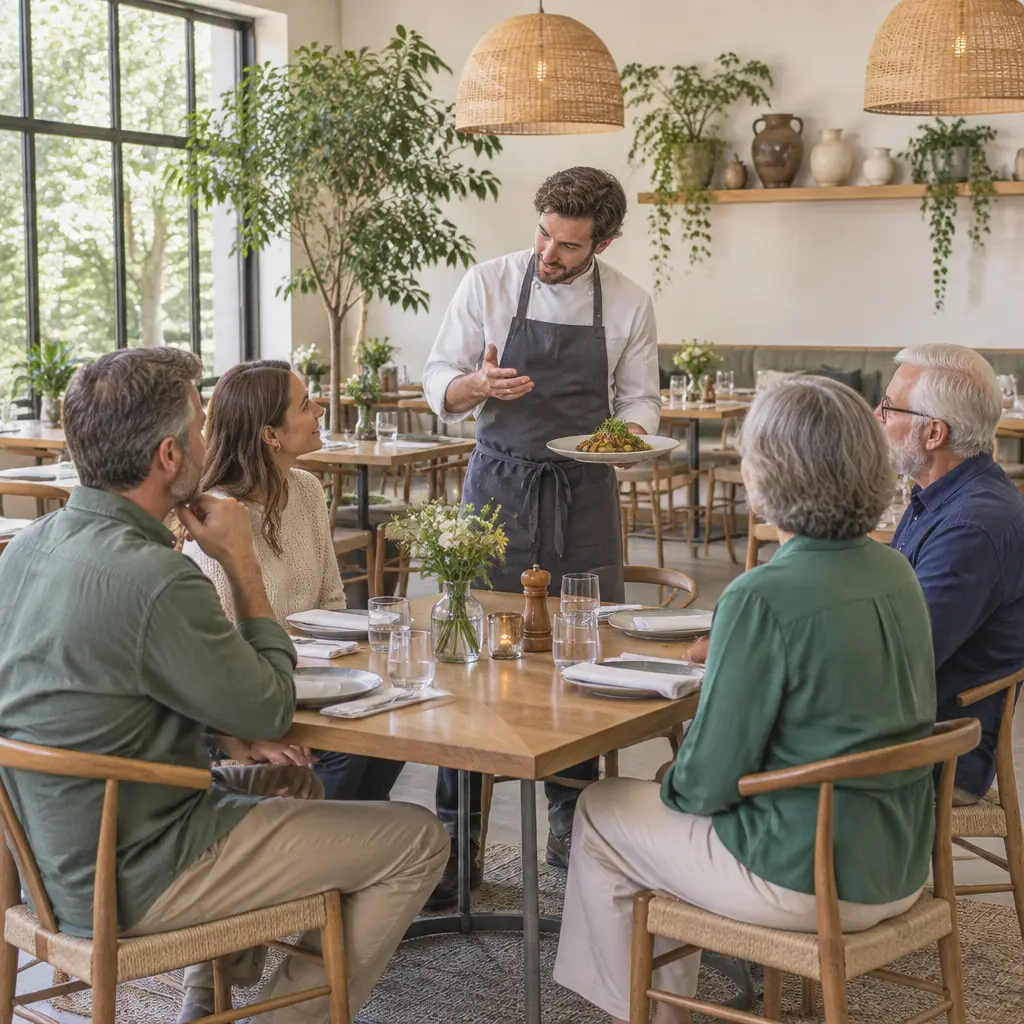
Immersive dining narratives are carefully designed stories, settings, and sensory cues that give a meal meaning while keeping the food at the center. They work best when atmosphere and storytelling support diners’ attention to taste, aroma, and texture rather than compete with it. Research on multisensory perception shows that what people see, hear, and expect can influence how they experience food; meanwhile, the World Health Organization estimates that unhealthy diets are a major risk factor for disease, underscoring the broader importance of making eating engaging and memorable. This article explains how narrative design shapes flavor, distinguishes supportive immersion from distraction, and offers practical principles and examples for restaurants building a story around the plate.
How immersive dining narratives shape flavor perception
An immersive dining narrative is a coordinated experience in which food, service, setting, and sensory details convey a story or theme. It may be a historical menu, a place-based tasting, a chef’s account of an ingredient’s origin, or a theatrical meal with timed scenes. The key is integration: the narrative gives diners a useful frame for interpreting the dish without demanding more attention than they can give to eating.
Food perception is multisensory. Charles Spence, a professor of experimental psychology at the University of Oxford, has described how visual, auditory, and other contextual cues can shape flavor experiences. In a widely cited review in Flavour, Spence discusses evidence that music, plate color, and expectations can affect perceived taste and enjoyment. Such findings do not mean atmosphere can substitute for good cooking; rather, they show why a coherent environment can amplify food’s qualities—and why conflicting or intrusive cues may undermine them.
Sensory congruence: when the story fits the dish
Sensory congruence means that the narrative and surrounding cues suit the food’s character. A coastal seafood course might be accompanied by restrained maritime references, while a smoky dish could be introduced through its cooking method or regional tradition. When cues feel consistent, diners can use them to anticipate and interpret flavor. A mismatch—such as loud, high-energy effects during a delicate tasting course—can pull attention away from aroma, texture, and finish.
This principle is related to crossmodal correspondence: people often associate particular sounds, colors, shapes, or textures with qualities such as sweetness, bitterness, or lightness. In its review of multisensory flavor perception, Spence notes that these associations can influence judgments, although their strength varies by person and context. Restaurants should treat them as design prompts, not universal rules, and test them with actual guests.
Narrative framing: expectations before the first bite
Narrative framing is the brief information that tells diners what a dish represents: its place of origin, an ingredient’s season, a producer’s practice, or a culinary technique. A concise explanation can focus attention on a meaningful quality—for example, the acidity of a local apple or the texture created by fermentation. It becomes counterproductive when the introduction is so long or dramatic that diners begin evaluating the performance instead of the food.
A classic demonstration of expectation’s influence comes from wine research. In a study published in the Journal of Marketing Research, Hilke Plassmann and colleagues reported that stated price affected participants’ reported pleasantness and activity in a brain region associated with experienced pleasantness while they tasted wine. The study is not a direct test of restaurant storytelling, but it illustrates a relevant point: information provided before tasting can shape reported experience. Ethical framing should therefore inform rather than mislead, especially about provenance, price, sustainability, or ingredients.
How immersive dining narratives preserve attention and appetite
Immersion is not the same as maximum stimulation. A successful dining narrative gives guests enough cues to understand the experience, then leaves room for conversation and sensory attention. This distinction matters because a meal already requires diners to process several streams of information: the food itself, companions, service, room noise, and any additional performance.
The U.S. National Institute for Occupational Safety and Health identifies 85 decibels over an eight-hour workday as its recommended exposure limit for occupational noise. That figure is a workplace safety benchmark, not a dining-room comfort threshold, but it underscores that sound levels are measurable and consequential. For restaurants, the practical objective is not simply to stay below a safety limit; it is to make speech comfortable and preserve the quiet details that help guests notice food.
Pacing and cognitive load
Cognitive load is the mental effort required to follow an experience. A sequence of short, well-timed introductions usually places less demand on diners than continuous narration, rapid scene changes, or instructions delivered while they are tasting. Give guests a moment to look, smell, and eat before the next story beat. For tasting menus, the kitchen and service team can coordinate each course so that information arrives before the bite it is meant to illuminate, not over the conversation that follows.
A practical test is to ask whether a guest can ignore the narrative briefly without missing essential information. If the answer is no, the experience may be too demanding. Menus, optional audio, and short server explanations give guests control over how deeply they engage.
Sound, lighting, and spatial cues
Soundscapes, lighting, tableware, and room layout are narrative tools, but each should serve a clear purpose. Soft, intelligible sound can establish a setting without masking conversation. Lighting can direct attention toward a dish, provided it does not distort the food’s appearance or make reading difficult. Tableware can evoke a region or material tradition while remaining comfortable and functional.
The Cornell Hotel and Restaurant Administration Quarterly has published research examining how music tempo and volume relate to restaurant dining behavior. Such work supports treating music as part of the service environment rather than as decoration without effect. Because results depend on the restaurant, clientele, and meal, operators should assess sound and lighting in their own space instead of assuming one atmosphere suits every course or audience.
Accessibility, consent, and choice
Accessible immersion offers different ways to participate. Some guests may enjoy theatrical sound, while others are sensitive to noise, light changes, scents, or unexpected interaction. Clear advance descriptions, quiet seating options, ingredient and allergen information, and permission to opt out of participation help ensure that a narrative enhances hospitality rather than becoming an imposed spectacle.
The Americans with Disabilities Act establishes requirements for access to public accommodations in the United States. Although a themed experience does not automatically create a particular legal obligation beyond applicable accessibility rules, inclusive planning is good service design: routes, menus, communication, seating, and sensory intensity should be considered from the outset.
Types of immersive dining narratives and their best uses
Immersive dining has several related forms, from understated place-based storytelling to elaborate performance. These approaches can be understood as hyponyms—specific types within the wider category of narrative-led dining. The right choice depends on the food, guest expectations, staffing, and the amount of attention a restaurant wants to devote to spectacle.
Place-based and provenance-led dining
Place-based dining connects dishes to a landscape, regional cuisine, or local supply chain. A server might explain a producer’s method, a seasonal harvest, or the cultural history behind a preparation. This form is especially well suited to menus whose ingredients and techniques genuinely reflect a place. Specific, verifiable details build trust; vague claims about “authenticity” or local sourcing can weaken it.
The National Restaurant Association’s annual industry research regularly identifies consumer interest in locally sourced foods and sustainability-related practices as menu trends. These reports describe stated interest and industry expectations, not proof that every diner will choose a particular dish. Restaurants can connect the story to real purchasing and disclose sourcing accurately, making provenance part of both flavor interpretation and accountability.
Chef-led and process narratives
A chef-led narrative focuses on decisions behind the dish: why an ingredient was selected, how fermentation changes it, or what a cooking technique contributes. It helps diners notice craftsmanship and can make unfamiliar foods more approachable. The most useful explanations are concrete and brief—what to look for in the aroma, texture, or finish—rather than a technical lecture that interrupts the meal.
This approach is particularly compatible with tasting menus, where a sequence can reveal a process or ingredient over several courses. The story should remain flexible for dietary needs and substitutions. If the kitchen changes a component, staff should update the explanation rather than repeat a narrative that no longer describes the plate.
Theatrical and technology-enhanced dining
Theatrical dining uses actors, staged service, projections, or scripted scenes; technology-enhanced formats may add sound, interactive displays, or augmented reality. These can create memorable settings, but they carry the greatest risk of competing with eating. A useful design rule is to place intense effects between bites or courses, and to keep the dish visible, accessible, and central during tasting.
A familiar real-world example is a chef’s counter, where guests watch food preparation while receiving a direct account of technique and ingredients. It creates immersion through proximity rather than elaborate effects. More technologically ambitious concepts should be evaluated with the same question: does the added layer help guests understand or enjoy the food, or does it merely add novelty?
How restaurants can design and evaluate flavor-first storytelling
A narrative should be developed alongside the menu and service plan, not added after the food is finished. The following sequence helps teams keep storytelling coherent, measurable, and guest-centered.
- Define the food’s central idea, such as a region, ingredient, technique, or seasonal change.
- Choose only sensory cues that reinforce that idea and do not obscure the dish.
- Write concise course descriptions that tell guests what to notice without prescribing what they must feel.
- Coordinate timing among the kitchen, service team, sound, lighting, and any performance.
- Offer alternatives for guests who prefer a quieter, less interactive, or more accessible experience.
- Test the meal with guests and revise based on feedback, observation, and service-team input.
Measure experience, not just spectacle
Evaluation should include more than social-media attention or ticket sales. Restaurants can ask guests whether the narrative helped them understand the food, whether they could converse comfortably, and which elements felt distracting. Operational indicators can include course timing, returned dishes, staff feedback, repeat bookings, and accessibility requests. These measures do not prove that a story caused a change in flavor perception, but together they show whether it improved the dining experience.
A simple comparison can help: invite a small group to experience a course with the planned introduction and another group to taste it with a minimal description, then compare specific feedback on aroma, flavor, and enjoyment. Keep the food and service conditions as consistent as possible, and avoid overstating results from a small informal test. The goal is practical learning, not a claim of scientific certainty.
A text-based design scorecard
The following scorecard can be used during menu development: rate each item from 1 (poor) to 5 (strong)—story-to-dish fit; clarity of the explanation; comfort of sound and lighting; time left for tasting and conversation; guest choice and accessibility. A low score on fit or guest choice is a signal to revise the concept before investing in elaborate production.
Conclusion: let the narrative lead guests back to the plate
Immersive dining narratives can deepen flavor by framing expectations, connecting food to place or process, and aligning sound, light, and service with the meal. Sensory congruence and concise storytelling support attention; excessive stimulation, poor pacing, or inaccessible participation can distract from it. Place-based, chef-led, theatrical, and technology-enhanced formats all have a role when they fit the food and the guests.
For restaurant teams, the practical next step is to test one narrative element at a time, ask diners what helped them notice the food, and make comfort and choice part of the design. For readers and operators seeking further context, consult the research on multisensory flavor perception, accessible service design, and current restaurant-industry reports. The strongest dining story is not the one that demands the most attention; it is the one that makes guests more attentive to what is on the plate.
Sources: Spence, Charles, “Multisensory Flavor Perception,” Flavour, 2015, https://flavourjournal.biomedcentral.com/articles/10.1186/s13411-015-0043-1; Plassmann, Hilke, John O’Doherty, Baba Shiv, and Antonio Rangel, “Marketing Actions Can Modulate Neural Representations of Experienced Pleasantness,” Journal of Marketing Research, 2008, https://doi.org/10.1509/jmkr.45.1.37; U.S. National Institute for Occupational Safety and Health, “Criteria for a Recommended Standard: Occupational Noise Exposure,” https://www.cdc.gov/niosh/docs/98-126/; U.S. Department of Justice, Americans with Disabilities Act, https://www.ada.gov/; National Restaurant Association, “What’s Hot Culinary Forecast,” https://restaurant.org/research-and-media/research/research-reports/whats-hot-culinary-forecast/; Milliman, Ronald E., “The Influence of Background Music on the Behavior of Restaurant Patrons,” The Journal of Consumer Research, 1986, https://doi.org/10.1086/209069.