
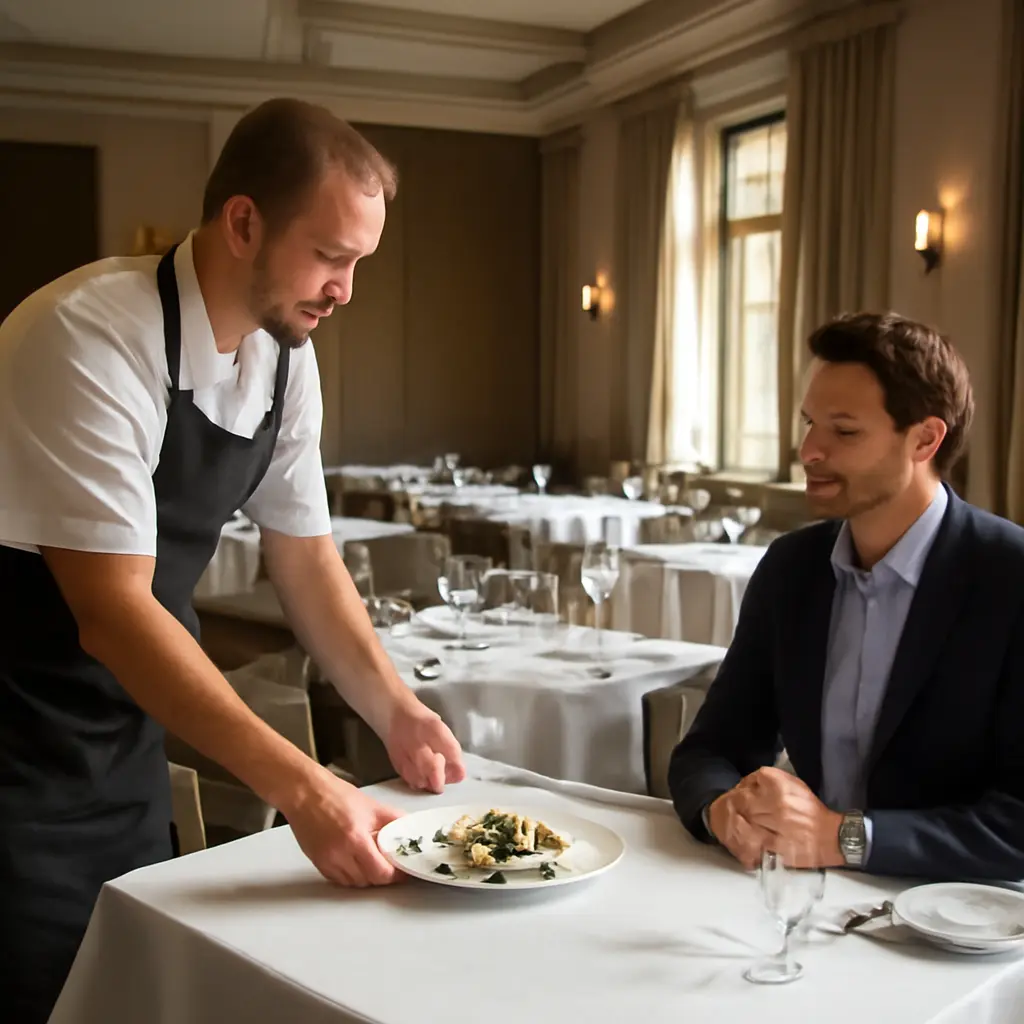
Michelin-starred restaurants are not abandoning courses so much as reshaping them into a continuous performance: a meal may unfold as a sequence of scenes, surprises, and interactive rituals rather than a familiar parade of starter, main, and dessert. Michelin defines its stars as distinctions for cooking quality—not for spectacle—and its inspectors assess factors including ingredient quality, technique, flavor, consistency, and the chef’s expression through cuisine. Yet restaurants such as Ultraviolet in Shanghai show how theatrical staging can become part of the experience around that cooking. The trend matters because it blurs the line between dinner and performance, while raising practical questions about value, accessibility, and whether theater enhances or distracts from the food.
Michelin restaurant theater reshapes the traditional tasting menu
A traditional tasting menu is a planned succession of small dishes that lets a kitchen present its ingredients and techniques in a deliberate order. The theatrical alternative keeps that progression but treats it as a narrative: courses may be linked by a theme, delivered with timed lighting or sound, or served through direct interaction between staff and guests. “Ditching courses” is therefore an evocative shorthand, not a precise description of every restaurant. Many theatrical Michelin-starred venues still serve multiple courses; what changes is how those courses are framed, connected, and experienced.
Michelin’s distinctions provide an important boundary for the discussion. The Guide says one star means “high-quality cooking, worth a stop,” two mean “excellent cooking, worth a detour,” and three mean “exceptional cuisine, worth a special journey.” Its published evaluation criteria focus on what is on the plate and the consistency of the experience—not whether a restaurant uses projections, music, or elaborate service. Theater can support a restaurant’s identity, but it does not substitute for culinary quality under Michelin’s stated framework.
Course sequence becomes a narrative rather than a checklist
In a conventional menu, courses are commonly understood through familiar categories such as appetizer, fish, meat, and dessert. A narrative menu may instead organize dishes around a place, memory, season, or imagined journey. The connection gives the meal a story arc: an opening establishes the theme, successive plates develop it, and a final course supplies a resolution. Individual dishes remain important, but their meaning can depend partly on where they appear in that arc.
This approach has roots in the broader history of fine dining. French chef Auguste Escoffier helped popularize service à la russe, in which dishes arrive sequentially, replacing the older service à la française, where many dishes were presented together. Contemporary theatrical dining does not simply reverse that history. Instead, it uses the established sequence as a stage on which chefs can build a more explicit narrative.
The room and service become part of the composition
Restaurant theater extends beyond food to include the dining room, staff choreography, sound, lighting, objects, and timing. A dish might be revealed under a cloche, introduced through a short explanation, or served in a setting designed to evoke a particular landscape. These elements can sharpen attention and make a meal memorable, but they also increase the importance of pacing and coordination: a theatrical sequence depends on the kitchen and front-of-house team delivering the intended effect together.
The distinction is useful: a restaurant can be immersive without abandoning courses, and it can offer a long tasting menu without being theatrical. The strongest examples make staging serve a culinary idea rather than operate as decoration on its own.
Immersive Michelin dining turns the restaurant into a stage
Immersive dining is an experience in which the restaurant deliberately uses multiple sensory or environmental cues to shape how guests interpret a meal. The term covers a spectrum, from carefully choreographed table service to projection-driven environments and location-specific storytelling. It is not a Michelin rating category; it describes a mode of presentation that a Michelin-listed restaurant may adopt alongside its food-focused identity.
Ultraviolet in Shanghai: a meal staged as a multisensory performance
Ultraviolet, created by French chef Paul Pairet in Shanghai, is a prominent example of highly staged fine dining. The restaurant’s format centers on a single table and a fixed, multi-course experience, with projections, sound, lighting, scents, and changes in atmosphere used to accompany dishes. Michelin has awarded Ultraviolet three stars in its Shanghai Guide, a reminder that theatrical presentation and Michelin-recognized cooking can coexist. Its format is not evidence that Michelin stars reward spectacle: Michelin’s stated criteria remain focused on the cooking.
The example also shows why “pure theater” can be misleading. Ultraviolet’s sensory effects are integrated into a meal that still has a sequence of dishes. The innovation lies less in eliminating courses than in turning their delivery into an orchestrated event. Because the restaurant’s format and recognition can change over time, prospective diners should check the current Michelin Guide entry and the restaurant’s own booking information before planning a visit.
Alinea in Chicago: theatrical presentation at the table
Chicago’s Alinea offers a different model: theatrical techniques are embedded in an ambitious tasting-menu experience rather than organized around a single projection-led environment. The restaurant is known for playful presentations and dishes that can turn the table or service itself into part of the reveal. Michelin lists Alinea as a three-star restaurant in Chicago. Its example illustrates a useful distinction: immersive dining can happen through intimate, tactile interaction as well as through large-scale audiovisual staging.
These cases sit within a wider set of related formats. Some restaurants use themed tasting menus; others rely on tableside finishing, surprise courses, performance, or technology. Each is a hyponym—a more specific form—of theatrical dining, but none requires a restaurant to discard the basic course sequence.
Theatrical tasting menus balance novelty with Michelin’s food standards
The central tension is whether presentation deepens the food or competes with it. Michelin’s five published criteria offer a practical way to assess that question: ingredient quality, mastery of cooking techniques, harmony of flavors, the chef’s personality expressed through cuisine, and consistency across visits. These criteria are useful because they separate the restaurant’s culinary achievement from the excitement of its setting.
When spectacle strengthens the dish
Theater can be culinary when it helps a guest notice aroma, temperature, texture, or an ingredient’s origin. A soundscape might reinforce a dish’s connection to a landscape; a tableside reveal might preserve a delicate texture until the moment of service. In these cases, staging is not merely an extra attraction—it helps communicate the chef’s intention and may make the food more legible or memorable.
A useful test is whether the experience still makes sense when the theatrical element is removed. If a dish has balanced flavor, technical precision, and a clear point of view without its projection or reveal, the staging may be amplifying a strong culinary idea. If the effect is the only memorable feature, the spectacle risks overshadowing the cooking.
Consistency is harder when every service is choreographed
The more a meal relies on precise timing, the more operationally demanding it becomes. Kitchens must coordinate dish readiness with lighting cues, sound, staff movements, and the pace of guests. A theatrical concept may also require specialized equipment and additional labor. Michelin does not publish a separate score for production complexity, and there is no reliable industry-wide statistic showing that theatrical restaurants are more or less consistent than conventional tasting-menu restaurants. The relevant evidence is restaurant-specific: repeatable cooking and service are central to Michelin’s stated assessment.
That operational pressure has a guest-facing consequence. A fixed sequence can make the experience feel carefully authored, but it can also leave less room to linger, skip a component, or change the rhythm. Clear communication about duration, dietary restrictions, accessibility, and the degree of interaction is therefore part of good hospitality, not an administrative afterthought.
The economics and accessibility of dinner as theater
A theatrical tasting menu is a product as well as a meal. The price may reflect ingredients, labor, equipment, room design, and a limited number of seats, but it does not guarantee that every guest will value those elements equally. The Michelin Guide itself does not set restaurant prices or promise that a star indicates affordability. Diners should compare the full experience—food, drinks, service charges, duration, and booking terms—rather than treating a star as a simple measure of value.
Fixed menus can narrow choice
A tightly choreographed menu often depends on serving a planned sequence to the room, which can limit substitutions and spontaneous choices. This may be challenging for guests with allergies, religious dietary requirements, sensory sensitivities, mobility needs, or a preference for a shorter meal. A restaurant’s willingness to accommodate requests varies, so guests should contact it in advance and ask specific questions rather than assume that a theatrical format is either fully flexible or inherently inaccessible.
Accessibility also involves more than the menu. Lighting, loud sound, strong scents, close staff interaction, and prolonged seating can affect whether an experience is comfortable. Restaurants that describe these features clearly allow guests to make informed decisions and give staff a chance to plan reasonable accommodations.
A practical checklist for diners
Before booking, diners can evaluate whether the spectacle suits their preferences by checking the format and asking:
- How many courses are served, and how long does dinner usually take?
- Is the experience communal, private, or centered on a fixed seating time?
- Can the restaurant accommodate allergies and dietary requirements?
- Does the meal involve projection, loud sound, scent, darkness, or interactive service?
- What is included in the price, and are drinks, service charges, or transportation separate?
These questions help distinguish a restaurant’s culinary offering from its production format. They also make clear that a memorable meal need not be the most elaborate one: for some diners, thoughtful cooking and attentive service matter more than sensory effects.
What the move toward restaurant theater means for fine dining
The shift toward theatrical fine dining reflects a broader effort to make a restaurant visit feel distinctive in an experience-driven leisure market. But the available evidence does not support a claim that Michelin restaurants as a whole are abandoning traditional courses. Michelin’s rating system continues to evaluate cooking, while prominent theatrical venues demonstrate that narrative, staging, and sequential menus can coexist.
For chefs, the opportunity is to make a restaurant’s identity more vivid without allowing presentation to eclipse flavor or consistency. For diners, the useful question is not whether a meal is “real dining” or “just theater,” but whether its performance adds meaning, pleasure, and hospitality to the food. For the industry, the challenge is to make increasingly elaborate experiences transparent, inclusive, and operationally sustainable.
In short, Michelin restaurant theater is best understood as an evolution in how tasting menus are staged, not proof that courses have disappeared. Michelin’s criteria explain why cooking remains the benchmark; Ultraviolet and Alinea show how different forms of theatricality can sit alongside that benchmark; and questions of price, pacing, and accessibility determine whether the experience works for the guest. Readers interested in a particular restaurant should consult its current Michelin Guide listing and contact the venue directly about format, timing, and accommodations.
Sources: Michelin Guide, “What Are the Michelin Stars?”, https://guide.michelin.com/en/article/features/what-is-a-michelin-star; Michelin Guide, “The MICHELIN Guide’s 5 Restaurant Rating Criteria,” https://guide.michelin.com/en/article/features/what-is-a-michelin-star; Michelin Guide, Ultraviolet by Paul Pairet restaurant listing, https://guide.michelin.com/en/shanghai-municipality/shanghai_2296775/restaurant/ultraviolet-by-paul-pairet; Michelin Guide, Alinea restaurant listing, https://guide.michelin.com/en/illinois/chicago_2544484/restaurant/alinea; Encyclopaedia Britannica, “Auguste Escoffier,” https://www.britannica.com/biography/Auguste-Escoffier.